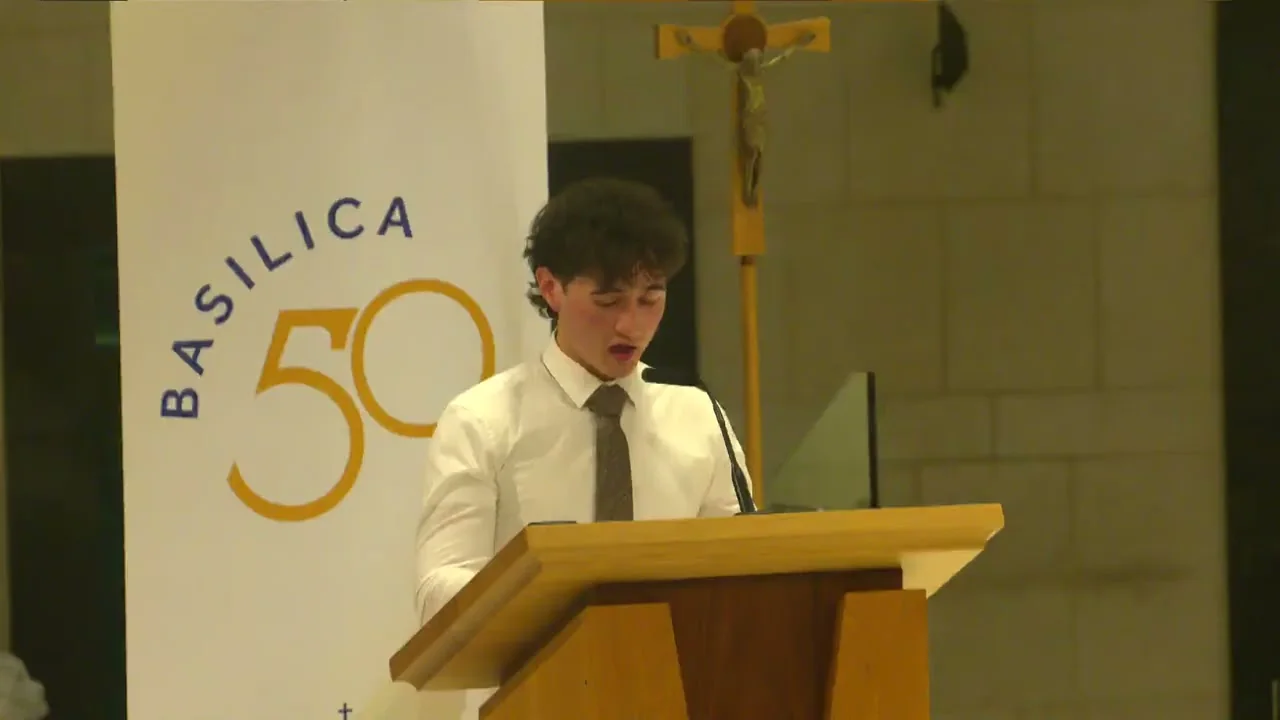
A young man stood at the lectern in the Basilica at Knock this month and put a question to the people in front of him — and, he said, to the young people especially. Have you ever been afraid to express your faith publicly? He then spent the next quarter of an hour answering it out of his own life. The last turn of that story is one every legionary ought to hear, because it turns on somebody doing exactly what we are asked to do every week.
The rosary he did not want to pray
He was born and raised in the faith, and says he fell in love with Jesus and Our Lady young. The credit he gives is not to himself. It goes to his parents, who brought him and his sisters to Mass every week and who made, in his words, “an immense effort to pray the rosary every single night.”
He is honest about how that felt at the time. He used the beads to count his Hail Marys and quietly cheered the last one, because he wanted it finished. It was a routine, he says, and he could find no meaning in it. Only looking back did he understand what had been going on: what he took for a routine was “actually laying down the very foundations of my faith.” He borrows an image from St Carlo Acutis — that after the Eucharist the rosary is the shortest ladder to heaven — and reckons that every Hail Mary was another rung, built without his noticing.
The years he prayed with the door shut
In primary school he was a quiet child who was, by his own account, fearless about the faith. He would pray the Angelus in front of everyone at seven or eight years old, with eyes on him from every direction, and it did not trouble him. He calls that childlike innocence: children do not yet fear the world’s opinion.
Then came secondary school, and the innocence went. He still believed. He still prayed. He still went to the sacraments. What changed, he says, is that he began to live his faith privately, because he had come to fear other people’s opinions more than he feared God. He was afraid to bless himself in public and on the bus, too afraid to pray before eating his lunch, and some nights the rosary lost out to homework or to the phone. His own verdict on those years is blunt: he had become “a lukewarm Catholic.”
Volunteering, and a question asked at adoration
The turn came through volunteering at the shrine. Serving the pilgrims who arrived, he began — for the first time, he says — to see Jesus in everyone he met, and he found himself telling people the story of Knock and shaping their day there while he was still struggling with his own faith. He puts it plainly: we can become part of other people’s journeys without realising the impact we are having.
A little over two years ago he kept a Lent he finally understood — fasting, praying and giving alms, as he says, with intent, and offering the lot. A few days after Easter he was at adoration, tired and still aware that something was missing, and he surrendered in as many words: Lord Jesus Christ, I surrender myself entirely to you. You take over my life. Then, as adoration was ending, he squeezed in one more question — what is it that you want me to do for you?
The answer was standing at the door
He was on his way out of the church when a lady stopped him and spoke to him about the Legion of Mary. She invited him to a meeting and asked him to consider joining.
A million reasons to say no arrived at once. Then he remembered what he had asked Our Lord about five minutes earlier, and he said yes. Driving home he smiled and told Jesus it had been “a little too fast.”
Why we are sharing this
A young man asked God for something to do, and God’s answer was a woman with an invitation. No campaign, no programme — one legionary doing the ordinary weekly work of asking. Whoever she is, she almost certainly walked home that evening with no idea what had just happened. That is worth remembering the next time the book of work feels unremarkable.
What he says it has done
“The Legion of Mary has taught me to embrace my faith, not to be discouraged and to have complete trust in God and Mary.” And then, standing in front of a basilica full of people, the line that answers the question he opened with: he is no longer afraid of the opinions of others.
He closed by asking everyone present to check their pockets — a phone, a wallet, a set of keys — and then asked whether they had brought their faith with them too, or whether they had left it at home.
God bless you, and Hail Mary Immaculate!